
CS Re-Architected Part 5 of 6: A Maturity Model that actually matters.
March 12, 2026
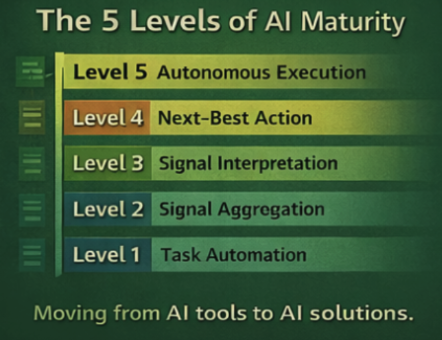
The progression from where most organizations are today to a proactive “AI operating layer” follows a clear maturity path.
Understanding where you sit on this spectrum is the first step to building a realistic plan.
Level 1: Task Automation AI handles low risk, repetitive tasks: drafts, meeting recaps, QBR outlines, follow ups. The value is real: productivity gains and a higher baseline quality for routine communications. This is firmly “tools” territory valuable, but not transformational.
Level 2: Context Aggregation AI synthesizes account data across systems: account summaries, renewal briefs, interaction history, executive snapshots. This saves prep time, reduces missed context, and improves internal alignment. But here’s the trap: many teams think they’ve achieved Level 2 because each tool has “AI features.” If your CRM has AI, your CSP has AI, and your call tool has AI but they don’t share context you don’t have cross system aggregation. You have AI in parallel silos.
At its best, Level 2 expands beyond internal systems into external intelligence: monitoring news, filings, leadership changes; competitive signals at a scale no CSM team can manually replicate.
Level 3: Signal Interpretation AI identifies patterns and emerging risks: churn detection, usage anomalies, activation lag, sentiment shifts. This is where reactive starts becoming proactive because the system can monitor hundreds of accounts for subtle shifts teams can’t track continuously.
Level 4: Next Best Actions AI recommends prioritized actions based on multi-signal input: save plays, onboarding nudges, escalation prompts, expansion triggers. But Level 4 only improves through feedback loops: Did the rep execute it? Did it work? Was it a false positive? Closed loop learning is what turns recommendations into a maturing system.
Level 5: Autonomous Execution AI executes actions within guardrails: automated onboarding steps, milestone progression, escalations, nudges, exception routing. This delivers operational scale but requires clean data, strong governance, and clear exception handling.
Here’s the honest market reality:
Level 1 is widespread.
Level 2 is common in intent but rarer in true execution.
Level 3 is emerging.
Level 4 is limited to innovators.
Level 5 is still early pilot territory.
And that’s okay.
The mistake is skipping levels or assuming you’re higher than you are because vendors call features “AI.”
There’s also a key distinction worth internalizing:
MIT Sloan’s research draws a line between “GenAI tools” (productivity) and “GenAI solutions” (business returns through system level change).
The leap that matters is from tools to solutions.
Your operating layer isn’t a copilot.
It’s a system change.
Sources used in this paper: Sage CS Advisory (2026); MIT Sloan; Gartner; McKinsey; SEI; Gainsight; Salesforce; ChurnZero.)