
CS Re-Architected Part 4 of 6: The Problem isn’t execution, it’s flawed design.
March 11, 2026
Here is the tension defining this moment: Most CS organizations today are structurally reactive.
Not because people aren’t capable or motivated.
But because the systems and workflows they rely on were designed to aggregate past signals and present them for employeeinterpretation.
A CSM prepares for a renewal call by:
Pulling data from the CRM (what happened)
Reviewing health scores (a lagging composite of engagement)
Scanning calls from weeks ago (what was said is already outdated)
Reading support tickets (problems that already surfaced)
By the time they act, the customer’s experience has already been shaped.
This is why the same pain points persist across CS orgs:
Signal overload
“Too late” risk detection
Inconsistent interventions
Manual executive storytelling
Underpowered CS Ops
Difficulty proving ROI in business terms
It’s not a talent problem.
It’s structural. A design flaw, an architecture problem.
And the data confirms what most CS leaders already feel.
The Gainsight CS Index highlights integration complexity as the number one barrier to AI adoption in Customer Success aheadof output reliability and data privacy.
That’s not a minor obstacle.
It’s the broken foundation.
If systems are fragmented, AI agents don’t share context.
If health scores miss sentiment or overweight the wrong signals, deploying more AI doesn’t solve your problem.
It scales it.
But AI now makes a different architecture possible.
Starting with the end in mind. Before we start, it helps to see the destination.
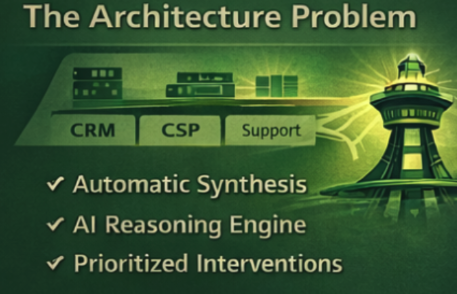
Imagine a CS operation where AI functions as an operating layer across all systems.
Not replacing your CRM, your CSP, or other intelligence tools.
Your systems of record remain.
The key difference: AI becomes a cross-system reasoning and orchestration layer that sits between those tools and your People teams.
At maturity, that layer:
Interprets signals across systems in real time
Synthesizes sentiment and risk context from disparate sources
Recommends prioritized next best actions
Drafts outputs like emails and renewal briefs with accurate context
Executes defined workflows autonomously inside guardrails
Think of it as a “control tower” model.
People oversee risk and value narratives.
AI continuously monitors signals, drafts briefs, and proposes interventions in real time.
People do what they do best:
Navigate complex stakeholder dynamics
Handle escalations where trust matters
Make judgment calls under ambiguity
The outcome chain is powerful:
Earlier intervention → faster adoption → better time-to-value → stronger retention → more expansion → better coverage without linear headcount growth.
That’s the promise.
But you don’t get there by “turning on AI.”
You get there by building toward it deliberately.
You reach the destination when you Re-architect CS.
Sources used in this paper: Sage CS Advisory (2026); MIT Sloan; Gartner; McKinsey; SEI; Gainsight; Salesforce; ChurnZero.)