
CS Re-Architected Part 3 of 6: Customer Success isn’t ‘behind’ in AI-Adoption, it’s different.
March 10, 2026
Most conversations about “AI for business” don’t take into account for makes Customer Success fundamentally different from other departments. It’s the reason BDR who can’t make quota, or your new logo sales rep who is ‘great with people’ don’t automatically make phenomenal CSMs.
So let’s get specific.
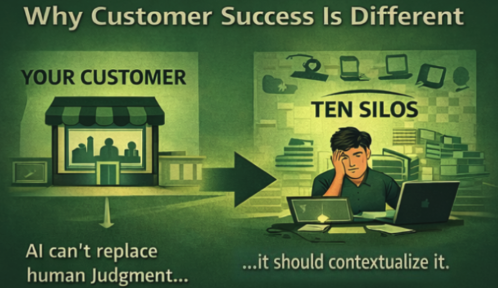
Your customer experiences one company. Yet your CSM is forced to work across ten operational silos, coordinating with ten teams, navigating twenty systems, and synthesizing seventy data points to deliver that single experience back to the customer.
Customer Success is responsible for outcomes: retention, expansion, satisfaction, adoption but depends on outputs from: product, engineering, support, sales, and marketing to deliver on those outcomes.
These are teams they influence, but don’t control.
That makes CS a team sport with a uniquely human component. The best CSMs carry institutional knowledge and context that no dashboard captures.
They understand the emotional landscape of a customer relationship:
Which stakeholder is quietly frustrated but hasn’t escalated
Which sponsor needs to feel heard before engaging on strategy
When “everything is fine” actually means “we’re evaluating alternatives”
When a customer’s tone shifts in a way no health score recognizes
They navigate escalations where empathy matters more than data.
They read nuance where the right move isn’t in any playbook.
AI is increasingly capable of analyzing language, tone, and even video.
But engaging with genuine emotion, understanding your customers annual priorities, making judgment calls in ambiguity, and bringing the human presence that builds trust in high-stakes moments those remain distinctly human capabilities.
That’s what makes Customer Success as much art as science.
Here’s where most AI conversations go wrong: They focus entirely on the science side: Automating drafts. Accelerating summaries. Speeding up analysis.
That matters.
But it misses the other equally important lens: Leveraging insights from customer facing teams to make the entire system more intelligent. Driving outcomes that are actually meaningful: retention, growth, deeper value without proportionally scaling cost.
Your CSMs are closest team member to the customer’s actual experience. Not the experience design, what they experience in practice; not theory.
A feedback loop should exist: pattern recognition, relationship intuition, and contextual knowledge should be feeding inputs to the AI system not just consuming outputs from it.
Your CSMs already provide inputs, albeit manually. They log notes. They update the CRM. They track health.
But at scale, we know the truth: The data entry burden competes directly with the relationship work that actually drives retention.
This is where AI must work in both directions.
The system should automatically capture the signals that don’t require employee data entry:
Call sentiment
Product telemetry
Support patterns
Engagement cadence
Milestone progression
So CSMs aren’t spending their limited time on manual documentation.
That frees them to contribute what only they can:
Contextual insight
Relationship pattern recognition
“Something feels off” intuition
Exception handling in the grey area
Stakeholder dynamics
And crucially those employee inputs can become the learning loop that makes the system smarter.
When a CSM flags that a health score doesn’t match reality, that’s training data.
When they note that a segment consistently struggles at a specific onboarding milestone, that’s signal refinement.
When they recognize a subtle sentiment shift in a stakeholder thread, that’s human intelligence improving the system’s interpretation layer.
The organizations getting this right aren’t just deploying AI to serve CS teams.
They’re designing systems that reduce manual burden and capture employee judgment efficiently, so the AI layer becomes more accurate, more nuanced, and more aligned to outcomes over time.
That’s art and science working together.
Sources used in this paper: Sage CS Advisory (2026); MIT Sloan; Gartner; McKinsey; SEI; Gainsight; Salesforce; ChurnZero.)