
CS Re-Architected Part 2 of 6: The Economics of AI-led Customer Success
March 9, 2026
Before we go any further, let’s ground this in dollars because that’s what makes the rest of the AI conversation resonate differently.
Customer Success is one of the clearest efficiency levers in any SaaS business because retention compounds. Bain & Company have long argued that even modest improvements in customer retention can materially lift profits.
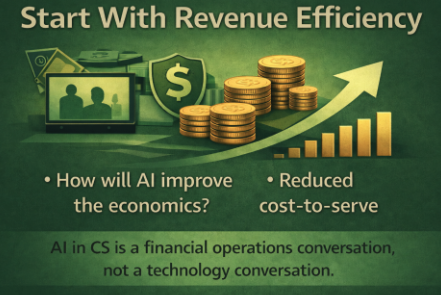
When you combine that with today’s reality, CS organizations being asked to reduce churn, drive expansion, and prove ROI under real economic constraint. The case for AI isn’t a technology story.
It’s a financial operations story.
The real question isn’t: “Should we use AI in CS?”
Rather, it’s: “How do we use AI to protect and grow the revenue we’ve already earned without proportionally growing the cost to do so especially as the business scales?”
Because you can’t scale a CSM team at the same rate you scale your customer base. Regardless of your account coverage model, as your base grows from 100 customers to 1,000 to 10,000...
At some point, the math breaks.
And when it breaks, leaders typically default to one of two moves:
Increase headcount to maintain coverage
Reduce engagement and accept the churn risk
Neither is a great option.
What changes the equation is an operating model that can direct employee attention with precision and a technology layer that supports that model at every stage of growth.
That’s why framing matters so much.
If you frame AI as “tools,” you end up asking:
Which platform has the best AI features?
Which vendor demo is most impressive?
Which can we roll out quickly?
But if you frame AI as economics, you ask a completely different set of questions:
What operating model changes will drive measurable financial outcomes?
Where do we need earlier signals to protect retention?
How do we increase coverage ratios without degrading the customer experience?
Which interventions actually move GRR and NRR?
That’s the difference between AI that delivers value and AI that becomes expensive shelfware.
Boston Consulting Group has reported that 74% of companies have yet to show tangible value from AI, even after years of pilots.
That’s not primarily a technology problem.
It’s an execution discipline problem.
And in Customer Success, execution discipline is inseparable from operating model clarity.
This is why “time saved” is not the end goal. It’s an input to the goal.
Time saved only matters if it translates into:
Earlier interventions
Faster time-to-value
Better retention performance
Stronger expansion motions
Lower cost-to-serve
That’s the value creation that owners want to see.
Not because they’re anti-operator, but because they’re accountable to value creation and sustainability.
And retention is one of the most direct, compounding mechanisms of value creation in SaaS.
So yes, talk about efficiency. But don’t stop there.
Build the case in business terms: Revenue protected. Growth accelerated. Revenue efficiency improved. That work happens in the checklist phase 1 of the CS Re-Architecture Model: Foundation & Limits.
In this phase we partner with leadership teams to answer questions like:
Which signals actually indicate retention risk today?
Where does customer intelligence live across systems and teams?
Those answers become the foundation for an operating model that allows AI to improve outcomes.
Because when the economic framework is clear, technology becomes an accelerator rather than an experiment.
And instead of the math breaking as the business scales, the operating model finally makes the math work.
Sources used in this paper: Sage CS Advisory (2026); MIT Sloan; Gartner; McKinsey; SEI; Gainsight; Salesforce; ChurnZero.)