
CS Re-Architected Part 1 of 6: The Tension
March 6, 2026
If you lead a Customer Success organization right now, you’re almost certainly caught in a version of the same conversation.
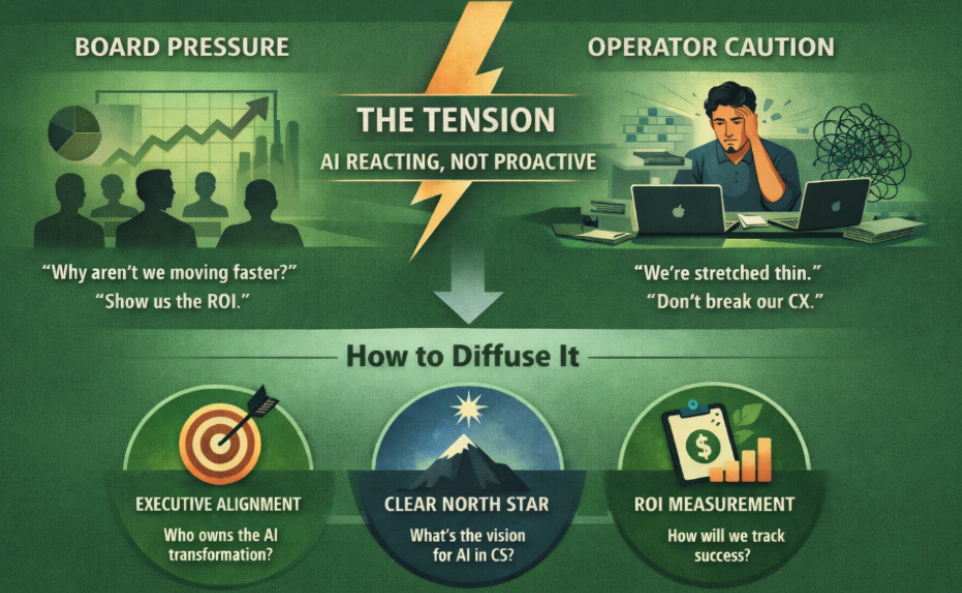
From the top, the pressure is clear:
AI is transforming every function. Competitors are moving. Investors want to see efficiency gains and a path to scale. The mandate is to re-architect how CS operates and to do it quickly.
That pressure isn’t abstract. Gartner has reported that more than 75% of customer service and support leaders feel executive pressure to implement GenAI. The dynamic in Customer Success is the same: top-down urgency colliding with bottom-up caution.
From the operating floor, the reality is different.
Your team is already stretched thin. Your systems are fragmented. Your CSMs are managing dozens or hundreds of accounts across tools that don’t talk to each other, relying on a mix of data, intuition, and tribal knowledge to keep customers on track.
The last thing they need is a poorly planned AI rollout that creates more confusion than clarity.
Both sides are right. And both sides are talking past each other.
Because here’s what’s happening in most CS organizations:
AI is making teams react faster without making them more proactive.
Yes, the drafts are faster.
Yes, the summaries are cleaner.
Yes, the prep is lighter.
But the operating model is still largely the same:
You learn about risk after it’s already formed
You detect churn patterns too late to change the outcome
You spend employee time synthesizing context across multiple tools
You scramble to assemble executive narratives at the last minute
You’re forced to prioritize based on incomplete signals
If the underlying system is reactive, AI becomes a speed multiplier on reactive work.
That’s not transformation. That’s acceleration.
The organizations making real progress aren’t choosing between speed and caution.
They’re building a phased path that gives operators a practical starting point and gives leadership the confidence of a trajectory they can see, measure, and explain to a board.
In other words:
They’re not “adding AI.”
They’re rearchitecting Customer Success so it can become proactive safely, measurably, and without breaking the customer experience.
That’s what this series is about.
Not which tools to buy.
Not “quick wins.”
Not “we saved 49 minutes per CSM.”
A real path from:
AI as productivity → AI as an operating layer
Reactive CS → Proactive CS
If you’ve felt the disconnect, where leadership expects transformation and operators worry about chaos, you’re not behind.
You’re at the inflection point.
Sources used in this paper: Sage CS Advisory (2026); MIT Sloan; Gartner; McKinsey; SEI; Gainsight; Salesforce; ChurnZero.)