
CS Re-Architected Part 6 of 6: Execution & Frontier
March 13, 2026
Here’s the single most important thing to understand about AI in Customer Success: AI can’t create an operating system where there isn’t one. It can only accelerate or amplify the one you already have.
If your segmentation is unclear, AI will automate unclear motions. If your health scores are broken, AI will scale decisions off broken health scores. If your playbooks are inconsistent, AI will generate inconsistent recommendations faster.
That’s why rearchitecting the model comes first.
Foundations like segmentation, lifecycle clarity, trusted health measurement, onboarding frameworks, success planning, and renewal discipline are not “prework.”
They are the work.
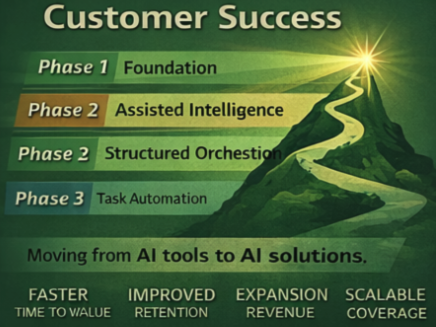
With that in mind, here’s the phased approach we recommend.
But first: one thing most roadmaps ignore.
Change management is not optional.
The People side must be designed from Day-1, not bolted on after tools go live.
You need to answer:
How do we make it safe to trust AI recommendations?
How do we reward adoption without punishing experimentation?
How do roles change and how do we communicate those shifts clearly?
How do we capture feedback efficiently, so the system improves over time?
Now, the 30, 60, 90 plan:
Phase 1 (Days 1-30): Foundation and Limits
Goal: Stabilize signals and clarify operating model before automation. Activities:
Validate data stability across CSP/CRM/product telemetry
Finalize segmentation logic
Define AI boundaries (can/can’t)
Select initial low risk use cases
Design People in the loop model Deliverables:
AI governance framework
Approved use case list
Integration outline
Org change management plan Measure:
Activity metrics (connections validated, use cases defined, governance documented)
Phase 2 (Days 31-60): Assisted Intelligence
Goal: Give Employees real context and early signal. Activities:
Ingest CSP signals + call transcripts
Generate account summaries + risk reports
Pilot with a defined cohort Deliverables:
Pilot dashboard
Prompt library
Calibrated thresholds Measure:
Efficiency metrics (time saved, lead time on risk detection, onboarding throughput)
Phase 3 (Days 61-90): Structured Orchestration
Goal: Move from “insights” to “prioritized action.” Activities:
Next best action recommendations
Anomaly alerts
Renewal risk brief automation
Executive ready prep documents
Deliverables:
Updated operating model
AI assisted onboarding framework
Roadmap for expansion
Measure:
Outcome metrics (time-to-value, retention movement in pilot cohort, expansion identification accuracy)
Now the part leaders often miss:
Measuring “minutes saved” is not the point.
You need translation:
Time saved → cost saved
Earlier risk → retention protected
More capacity → expansion surfaced
Faster time-to-value → stickier adoption → better GRR/NRR
That’s how you defend investment in board terms.
Two final realities:
Agent sprawl is coming. If every function deploys disconnected agents, you don’t get an operating layer, you get integration chaos. Orchestration and governance are the difference between ROI and cancellation.
The frontier is product-native intelligence. The “virtual CSM” is not a chatbot. It is an embedded relationship surface that captures intent, detects friction in real time, and escalates Employees only when it matters.
This doesn’t make CS less human.
It makes people work more strategic.
And that is the point.
Sources used in this paper: Sage CS Advisory (2026); MIT Sloan; Gartner; McKinsey; SEI; Gainsight; Salesforce; ChurnZero.)